

|
Automated Robotic Grinding System for Metal Parts
| Brand Name: | DZ |
| Model Number: | DZ-PO02 |
| MOQ: | 1 Set |
| Price: | Negotiable |
| Packaging Details: | Wood Case |
| Payment Terms: | L/C,T/T |
4-Position Rotary Indexing Robotic Grinding Machine
,Dual Robot Parallel Processing Robotic Polishing Machine
,FANUC M-10iD/12 Robots Automated Grinding System
4-Position Continuous Production For Sanitary Hardware Finishing
The DZ Multi-Station Rotary Table Robotic Grinding System revolutionizes production throughput for sanitary hardware components by integrating a precision 4-position rotary indexing table with dual FANUC grinding robots operating in coordinated parallel processing. This innovative configuration enables simultaneous loading, rough grinding, finish grinding, and unloading operations across four discrete stations, eliminating idle time inherent in single-station robotic cells.
The 1200mm diameter rotary table indexes between positions in under 1.5 seconds with 0.02mm repeatability, while pneumatic clamping at each station ensures rigid workpiece fixturing during grinding operations. Purpose-engineered for high-volume production of faucet bodies, valve housings, shower components, and bathroom accessory parts in brass, zamak, and stainless steel, this system delivers up to 4x productivity improvement compared to conventional single-robot cells.
- 4-Position Rotary Indexing Table: Servo-driven 1200mm rotary table with hardened steel cam indexer provides four precisely positioned workstations. Each station accommodates interchangeable fixture plates with pneumatic clamping and part-presence sensing.
- Dual Robot Parallel Processing: Two FANUC M-10iD/12 robots work simultaneously at two grinding stations with coordinated scheduling ensuring zero idle time between table indexes for maximum throughput.
- Rapid Station Indexing: Servo-driven table achieves 90-degree index times of under 1.5 seconds with ±0.02mm positioning repeatability. Hardened steel shot-pin locking at each station maintains fixture position rigidity under full grinding forces up to 200N.
- Operator-Friendly Load and Unload: Station 1 features ergonomic part presentation at 850mm working height with dual-hand anti-tie-down cycle start buttons and light curtain protection for operator safety.
- Quick-Change Fixture System: Each station accepts modular fixture plates with standardized mounting interface, enabling complete production changeover between different part families in under 15 minutes.
- Integrated Part Cleaning: Station 4 incorporates automated air blow-off and vacuum cleaning that removes grinding debris from finished parts and fixture surfaces, ensuring consistent part cleanliness for downstream operations.
| Robot Model (x2) | FANUC M-10iD/12 |
|---|---|
| Number of Stations | 4 (load, rough grind, finish grind, clean) |
| Rotary Table Diameter | 1200 mm |
| Table Index Time | < 1.5 seconds per 90° |
| Positioning Repeatability | ±0.02 mm |
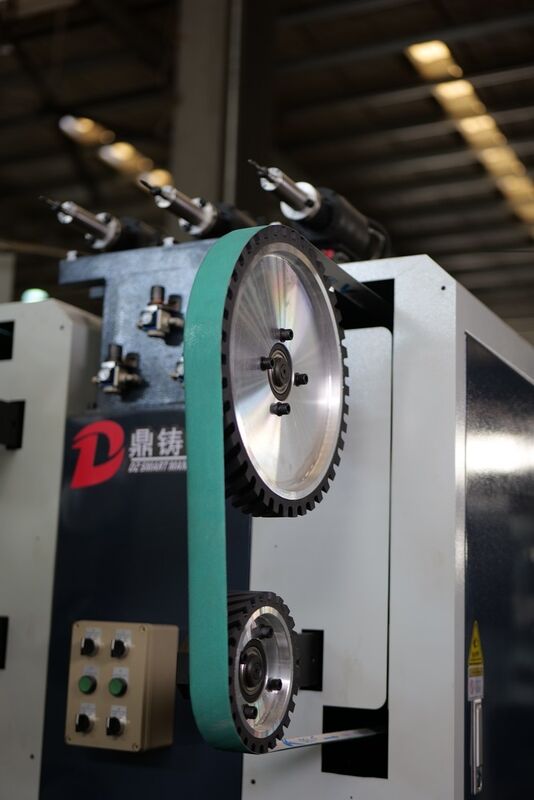
| Sand Belt (per robot) | 1 unit, 4KW |
| Total Installed Power | 20 KW |
| Typical Cycle Time | 15-25 seconds per part |
| Throughput | Up to 180 parts/hour |
| Rated Voltage | 380V / 50Hz 3-Phase |
| System Footprint | 3200 x 2800 mm |
Brass faucet body producers utilize this system for complete surface grinding of cast faucet bodies, achieving cycle times of 15-20 seconds per part across rough grinding of parting lines and finish grinding of visible surfaces. Zamak die-cast handle manufacturers processing large-volume production runs benefit from the continuous flow configuration, with one operator managing loading while finished handles accumulate for downstream plating.
Shower component producers processing multiple part variants utilize the quick-change fixture system to switch between part families without extended downtime. Valve manufacturers processing brass and stainless steel ball valve bodies employ the dual-robot system to grind both body exterior and flange face surfaces in a single fixturing, eliminating multiple handling operations required in single-robot cells for complete component finishing.
Each system undergoes complete assembly and testing at the factory including rotary table indexing accuracy verification, dual-robot collision avoidance testing, and sustained production runs processing 500 plus sample parts. The system is partially disassembled into major modules for international shipping in reinforced wooden crates with detailed assembly documentation and color-coded connection labeling.
DZ installation engineers perform complete system reassembly, alignment, and commissioning at the customer facility, followed by operator training on fixture changeover procedures. The 12-month warranty covers both robots, the rotary table mechanism, and all grinding equipment with optional quarterly preventive maintenance visits and productivity optimization support.
Q&A
Q1:What types of metal parts can Dingzhu's robotic grinding and polishing systems process?
A: Dingzhu's robotic grinding and polishing systems can be used for a wide range of metal parts, including faucets, sanitary ware, valves, door handles, automotive parts, motorcycle parts, aluminum castings, zinc alloy parts, and other complex metal components. The system can be customized according to the product shape, material and required surface finish.
Q2:Can Dingzhu provide a customized robotic grinding and polishing solution?
A: Yes. Dingzhu provides customized solutions based on the customer's products and production requirements. Our engineering team can design the robot program, grinding and polishing tools, fixtures, process parameters and dust extraction system according to the workpiece. Customers can provide product drawings, photos or samples for evaluation.
Q3:What advantages does robotic grinding have compared with manual grinding?
A: Robotic grinding provides more consistent processing quality and production efficiency than manual grinding. The robot can accurately follow programmed paths and maintain stable processing parameters, while reducing repetitive manual work and exposure to grinding dust. This makes the production process more standardized and suitable for continuous manufacturing.
Q4:Which industrial robot brands does Dingzhu work with?
A: Dingzhu develops robotic finishing systems using industrial robot platforms such as FANUC and ABB. Depending on the application, we can configure the appropriate robot, tooling, fixtures and control system to meet different production requirements.
Q5:Does Dingzhu provide complete automation solutions in addition to polishing machines?
A: Yes. Dingzhu provides integrated intelligent manufacturing solutions, including robotic grinding and polishing systems, automatic polishing machines, low-pressure die casting machines and related casting automation equipment. We can also integrate loading, unloading, conveying, dust extraction and other processes to create a more complete automated production line.

